
Undeniably, the landscape of climate finance is rapidly changing. From the provision stance, the language of climate finance is increasingly gravitating towards mobilization including through deployment of tools and instruments such as equities, guarantees, incentives amongst others to unlock and scale private sector capital for climate action. This shift, according to various sources including donor agencies, reflects a growing recognition that public finance alone is insufficient to meet the scale of the climate crisis. Instead, public funds are now being used strategically to de-risk investments and crowd in private capital, particularly in sectors such as renewable energy, sustainable agriculture, and climate-resilient infrastructure.
Accordingly, donors, multilateral agencies, and development partners are actively recalibrating their modus operandi. What was once framed primarily as development cooperation is increasingly taking on the characteristics of trade cooperation. Climate finance is no longer only about solidarity and support to developing countries; it is also becoming a vehicle for unlocking green business opportunities, often aligned with the commercial interests of foreign home-based private sector actors. This is evident in the growing emphasis on investment pipelines, public-private partnerships, and blended finance structures designed to position domestic companies from donor countries at the forefront of the global green transition. Yet beneath this transition lies a deeper question of justice.
While this shift is argued to accelerate the scale and speed of climate investments, it also raises critical justice concerns. When climate finance is driven by commercial viability and return on investment, there is a risk that priorities shift away from the most vulnerable communities toward projects that guarantee financial returns. In practice, this means that large-scale renewable energy projects or export-oriented green industries receive disproportionate attention, while locally led adaptation efforts; especially those led by smallholder farmers, women, and marginalized groups; remain underfunded; as indeed mobilization, by its nature, follows the logic of markets; favouring projects and actors deemed “bankable,” often at the expense of vulnerable communities who lack access to finance, collateral, or formal investment structures.
Unfortunately, without deliberate safeguards, this shift risks reinforcing existing inequalities, where capital flows to those already resourced, while frontline communities; those most affected by climate change; remain excluded. If this trend extends to mobilization for funds for responding to loss and damage and or adaptation, in many African contexts, including rural Kenya, Malawi, Ghana, Uganda and Tanzania etc. that are not only constrained fiscally but also burdened by the impacts of climate change, this could mean that communities facing devastating floods, prolonged droughts, and displacement are left navigating increasingly complex and market-oriented financing structures that are neither accessible nor responsive to their realities.
Loss and damage, by its very nature for instance, is not “bankable.” It does not generate financial returns, yet it demands urgent and sustained support. Similarly, adaptation efforts; such as strengthening local food systems, restoring degraded ecosystems, or investing in community-led resilience; often lack the revenue streams required to attract private capital. As a result, these critical areas risk being deprioritized within a mobilization framework that privileges profitability over vulnerability. For rural communities across Africa, this creates a troubling paradox. Those who have contributed least to the climate crisis are expected to adapt to its harshest impacts, while also fitting into financial models designed for profit-driven investments. A smallholder farmer in Malawi recovering from cyclone damage, or a fishing community in coastal Ghana grappling with erosion and saltwater intrusion, cannot be expected to access guarantees or equity-based financing instruments. Yet these are the very tools increasingly shaping the climate finance landscape.
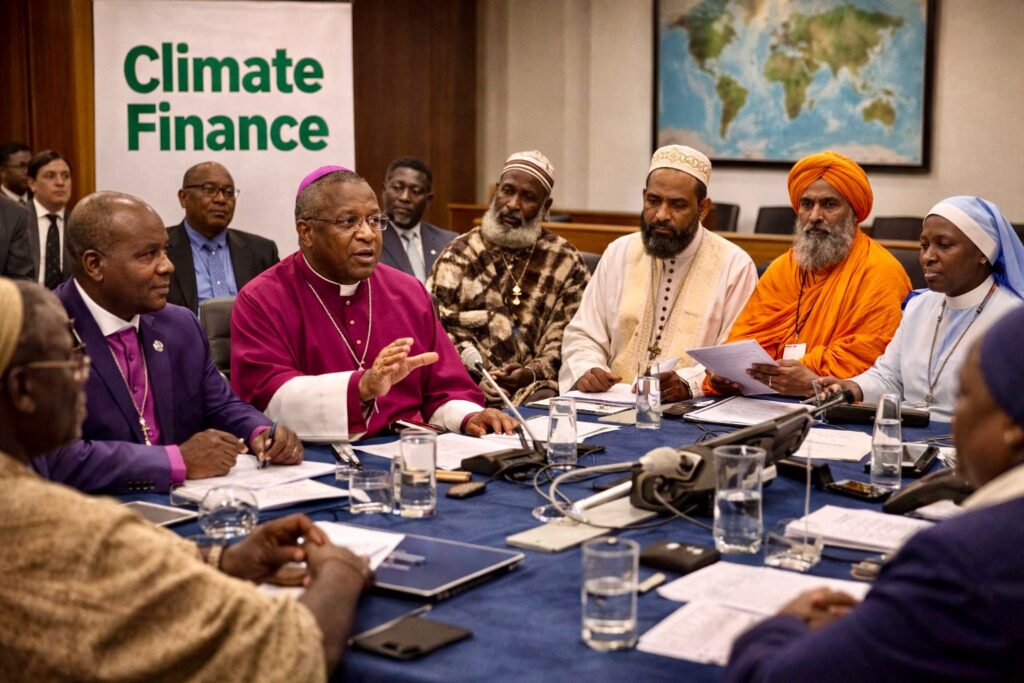
This is precisely why a faith-led intervention is both timely and necessary. For GreenFaith Africa, faith-based organizations are uniquely positioned to challenge the moral blind spots this purely market-driven approach to climate finance. Grounded in principles of justice, stewardship, and the inherent dignity of all people, faith organizations must now rise up and advocate for financing models that prioritize the needs of the most vulnerable from the very voices of affected communities, ensuring that climate finance is not only provided at scale but also distributed equitably. At its core, the shift from provision to mobilization is not just a technical or financial transition, it is a moral crossroads. The question is not only how much finance can be availed, but for whom, and under what terms. Without a justice-centered approach, mobilization risks becoming another mechanism through which inequality is reproduced under the guise of climate action.